BALANCEDPLANET

BalancedPlanet.world

Proven green technologies, put to work where they are needed.

I am Tony Kez, Vice President of International Affairs at ArchEnerg, a renewable energy cluster in Hungary. My work rests on one idea, the planet has limits. This has been proven decades ago and confirmed again and again. The job now is to deploy technology that already works, not to chase the next buzzword.

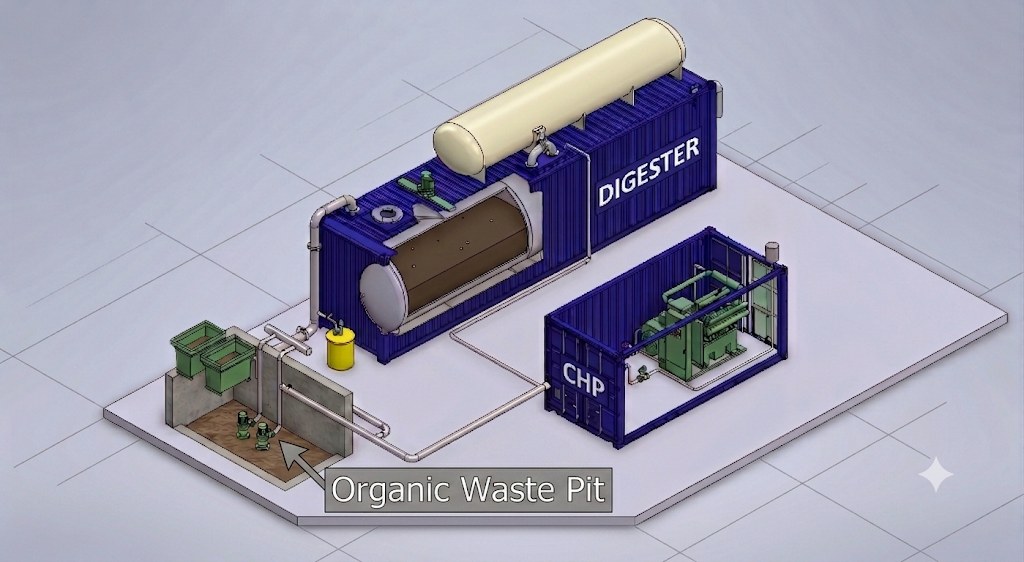
Isometric engineering illustration of a modular containerized biogas plant: organic waste pit, digester with gas holder, and a combined heat-and-power container.
Illustration: one of the proven technologies I deploy — a modular containerized biogas plant.

The idea

What a Balanced Planet means

In 1972 the Massachusetts Institute of Technology published a study called Limits to Growth. Its conclusion was simple. If we keep chasing growth (GDP growth) and using more and more, sooner or later we run into the planet's limits (ecological overshoot), whether we run short of resources, drown in our own pollution, or simply become too many. When we hit that point, growth stops and things start going backwards.

Think of a small lake in the countryside. A few people swim and fish in it, and it stays clean and full. Now build houses all around it, put more and more boats on the water, and take more fish out every year. At some point the lake can't recover. The water turns bad from the waste, the fish disappear, poisoned by the pollution and caught faster than they can breed, and the thing everyone came for is gone. The planet is that lake, just much bigger.

In 2020 a researcher named Gaya Herrington, as part of her Harvard master's thesis, checked those 1972 predictions against fifty years of what has actually happened. The real world has followed them closely. If we carry on the way we are (Business as Usual), the growth we are used to could start to stall around 2030.

~2030 growth could begin to stall · business-as-usual

Today there are two common answers, and I think both are wrong. One says keep growing at any cost, which is what most governments do, trusting that technology will clean up the rest. The other says consume less, and feel guilty for wanting a good life.

I do not believe in either. A balanced planet is the middle that actually works. Use what we have wisely, and stop wasting what we cannot replace. Put the green technology that already works to use, so life keeps running. And stop treating "more" as the only thing that counts. Balance is not sacrifice. It is where a good life and a living planet finally go together.

Balance is not only for economies and governments. It is also how each of us lives. It is picking up your garbage instead of leaving it on the ground. It is treating other people, and other places, with respect. It is taking what you need, enjoying your life, and not taking so much that little is left for your neighbour or for the next generation.

For example, instead of using plastic wrap or foil to cover a bowl of food, place a single plate over it. It saves the plastic and the foil. On its own it seems like almost nothing. But if everyone did it every day, it could keep an ocean of plastic out of the ground. No one action matters much on its own. Together, they are everything. A balanced life is not a smaller life. It is a fuller one.

Small habits are where balance starts. My work is where it scales.
The pipeline · three real projects

What I am building now.

01

Landfill gas recovery · Transylvania

A legacy landfill in Transylvania is venting methane into the air today. I am developing a recovery project to capture that gas and turn it into electricity. The landfill owner reduces a hazard and earns from the energy. The local grid gains power. In both cases, less methane reaches the atmosphere.

SiteTransylvania, Romania
TypeLegacy landfill gas recovery
StatusIn development · seeking financing
02

Used engine oil recycling · Serbia

In Serbia I am developing a used engine oil recycling facility. The technology is proven. However, the facility only works if there is a national collection network to feed it, and building that network is the real task. Garages and workshops get a legal, paid route for their waste oil. The facility gets steady feedstock. The soil and water get one less pollutant.

SiteSerbia
TypeUsed engine oil recycling
StatusIn development · seeking financing
03

Modular biogas · Hungary, Romania, Serbia & Uzbekistan

A herd of 85 cows can generate up to 120,000 kWh of electricity a year through biogas. I am developing modular biogas plants across Hungary, Romania, Serbia, and Uzbekistan on that principle, and in Uzbekistan I am in regular contact with the national energy ministry. Farmers become more competitive because they get cheaper energy. The host country adds local generation. Less carbon is emitted either way.

SiteHungary · Romania · Serbia · Uzbekistan
TypeModular biogas
StatusIn development · seeking financing

From waste to power

How a biogas plant works

01
Organic waste
Manure, food and crop waste
02
Sealed digester
Bacteria break it down without oxygen
03
Biogas
Captured and burned in a generator
04
Electricity & heat
Powers the farm or feeds the grid

What is left over, the digestate, goes back to the field as natural fertilizer. Nothing is wasted.

Isometric engineering illustration of a modular containerized biogas plant, with the organic waste pit, digester container with gas holder, and combined heat-and-power container labelled. 1 2 3 4
Illustration: a modular containerized biogas plant. The numbers match the four steps above.

The hard part

Where this breaks down is the financing.

The technology to do this already exists, and it gets better every year. The trouble is that proven solutions too often never reach the field. The projects are too small for the big development banks, whose minimums sit well above them. And they are too risky for local banks, which either turn them down or lend only at rates too high, and over too few years, to make the project work.

That gap, between half a million and three million dollars, is where I work. I find proven green technology, structure it into real projects, and work to bring the financing that gets them built, so the farmer, the investor, the community, and the planet all come out ahead. It is never good if there is a losing side.

By project size

Local banks
reject it or quote unworkable terms
$500K–$3M
the gap · where I work
Development banks
minimums sit above this
smaller projectslarger projects

Track record

Who is behind this.

I have done this work on the ground, not from a desk, in Hungary, Romania, Serbia, and Uzbekistan.

ArchEnerg

A renewable energy cluster based in Szeged, southern Hungary, two hours from Budapest near the Serbian and Romanian border. I am its Vice President of International Affairs.

Central Asia bridge

I am currently working, pro bono, to register an Innovation Cluster in Fergana, Uzbekistan on the European Cluster Collaboration Platform, to build a real bridge between European and Central Asian partners.

Background

Master's in Economics. Based in Montreal, working across Central and Eastern Europe and Central Asia.

Position

I am not selling a single technology. I connect proven solutions, the partners who host them, and the financing to make them real.

Where I work · from Central Europe to Central Asia

MontrealBase · Canada
SzegedArchEnerg · Hungary
TransylvaniaLandfill gas · Romania
SerbiaUsed-oil recycling
FerganaCluster · Uzbekistan

Be part of it

If it makes sense to you, join me.

That is a balanced planet. Not a perfect one. A workable one. If you fund, build, or host projects in the $500K to $3M range, or you simply want to help this happen, I would like to hear from you. Tell me which project interests you and what you bring to it.